
Hakmi Capital Group Expands Its Software Ecosystem With New Desktop Applications and Development Infrastructure
From artificial intelligence infrastructure to native desktop applications, Hakmi Capital Group is advancing a growing portfolio of internally developed technologies under a unified long-term vision.
OSLO, NORWAY | 31 October 2026
Hakmi Capital Group (HCG) is advancing the development of its technology ecosystem, with progress across software engineering, desktop applications, artificial intelligence infrastructure and enterprise management systems.
Following the recent introduction of HCG AI, the company has continued work on several interconnected platforms designed to support its operations, software products and future expansion.
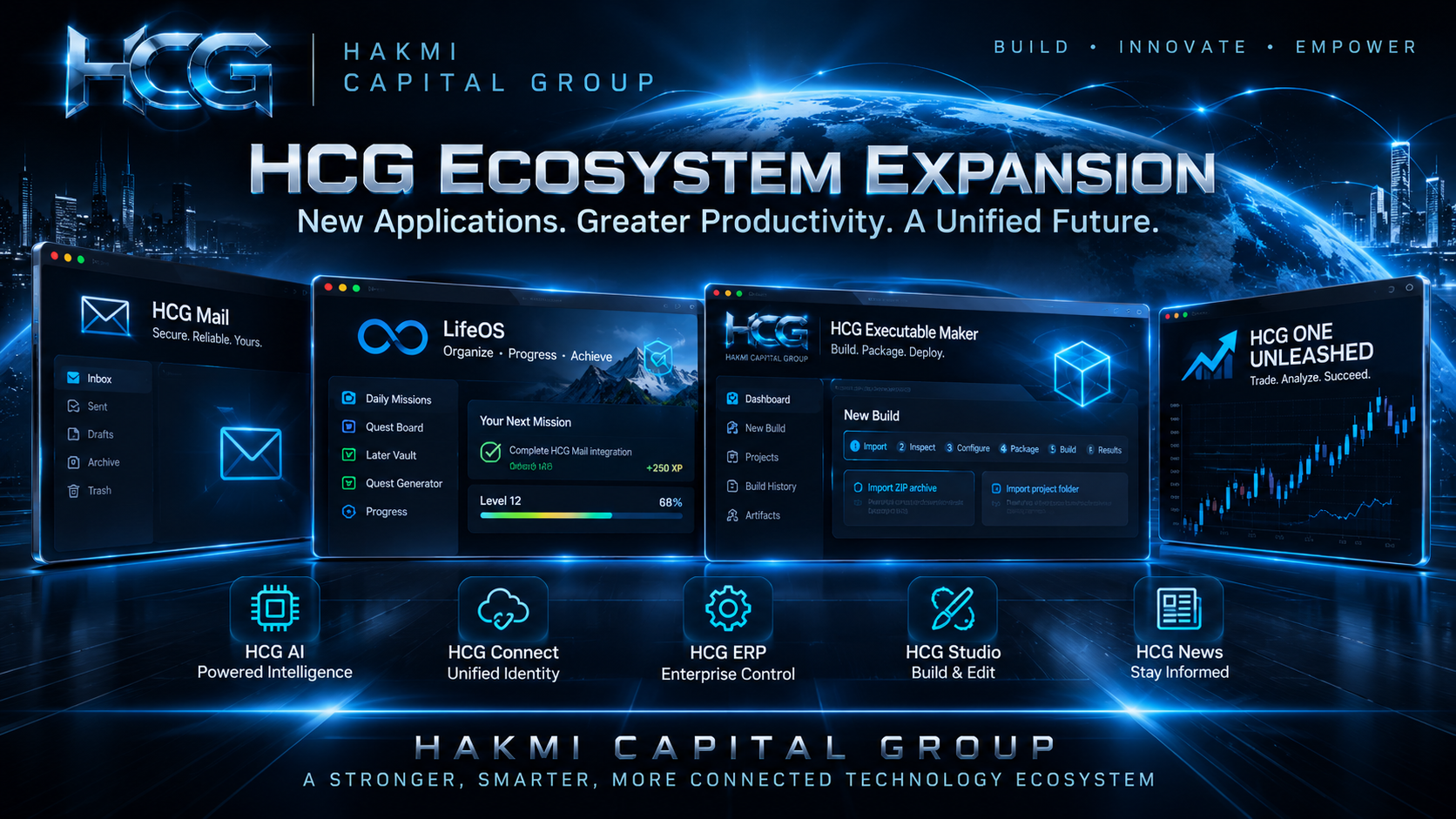
The latest developments include working desktop versions of LifeOS and HCG Executable Maker, ongoing development of HCG Mail and HCG ONE: UNLEASHED, and continued expansion of the company's central technology infrastructure.
Together, these projects represent HCG's ambition to move beyond individual software products toward an integrated technology environment.
HCG Executable Maker: Developing the Tools Behind the Software
One of the company's latest development milestones is HCG Executable Maker, a desktop application designed to simplify the process of building and packaging software for distribution.
Built using .NET and Avalonia, the application provides a graphical interface for importing projects, inspecting their structure, configuring builds, managing toolchains and producing application artifacts.
The platform has reached an early functional milestone, with its desktop interface successfully running on macOS. Development testing has also demonstrated a successful application build in a Linux environment.
Its interface includes a command center, project management, build history, artifact management, security settings and a structured packaging workflow.
The long-term objective is to provide HCG with greater control over how its software is prepared, tested and distributed across supported operating systems.
Additional verification of platform-specific packaging, signing and deployment capabilities remains part of ongoing development.
LifeOS: Turning Productivity Into a Progression System
HCG is also developing LifeOS, a productivity application combining task management with concepts drawn from role-playing games.
Rather than presenting tasks as a conventional to-do list, LifeOS organizes responsibilities into quests, missions and distinct areas of activity known as realms.
The application incorporates features such as Daily Missions, a Quest Board, a Later Vault, quest generation and experience-based progression.
A working macOS version is now operational.
The next phase involves replacing demonstration content with the founder's actual personal and business task backlog, connecting daily priorities to the broader development activities taking place across HCG.
LifeOS is being designed around a local-first architecture, allowing its core productivity functionality to operate independently of cloud services.
HCG Mail and HCG ONE: Expanding the Desktop Portfolio
Beyond its internal development tools, Hakmi Capital Group is progressing with two additional software projects.
HCG Mail is a desktop email application under development using .NET and Avalonia. Its current development work includes secure email connectivity, account management, cross-platform behavior and certificate validation.
The application has been launched in a macOS testing environment, although email connectivity testing has identified certificate-revocation validation issues that remain under investigation.
Separately, HCG ONE: UNLEASHED is being developed as a native macOS trading application, with work focusing on its trading engine, simulation capabilities and market visualization.
Both projects remain in active development, with further testing required before they can be considered production-ready.
Building a Unified HCG Technology Infrastructure
The expansion of the software portfolio is taking place alongside continued development of HCG's internal technology architecture.
The company's broader ecosystem includes HCG Connect, a shared identity framework; HCG ERP, an enterprise management environment; and executive-level systems intended to provide centralized oversight.
Rather than treating every new application as a completely independent product, HCG is pursuing an architecture in which identity, permissions, licensing and administrative controls can be coordinated through central systems.
This direction is intended to reduce duplication, simplify governance and provide a consistent foundation for future applications.
The company is also developing HCG Studio, an internal software and website editing concept designed to strengthen its development workflow.
These systems are at different stages of maturity, and their full integration remains ongoing.
The Role of HCG AI
Artificial intelligence remains an important part of Hakmi Capital Group's longer-term technology strategy.
HCG AI is intended to serve as a central service layer for AI-related functionality across the company's ecosystem, including model-provider integrations and future application capabilities.
The architecture emphasizes centralized governance rather than allowing individual applications to independently control identity, permissions or system-level authority.
A defining principle of the company's current approach is that security-sensitive changes, system rules and production modifications remain subject to manual authorization.
AI-assisted development may support engineering and operational work, but it does not replace the company's approval requirements.
From Individual Products to a Connected Ecosystem
The development of HCG News, HCG Executable Maker, LifeOS, HCG Mail, HCG ONE and the company's internal infrastructure illustrates the breadth of Hakmi Capital Group's current technology activities.
These projects serve different functions, but they are being developed within a common strategic framework.
Some have reached working application milestones. Others remain prototypes, architectural initiatives or active engineering projects.
The distinction is important: operating a development build is not the same as completing a commercial software release.
For Hakmi Capital Group, the immediate focus remains on improving functionality, strengthening security, validating technical architecture and developing the infrastructure required for further expansion.
The company's longer-term objective is to establish an interconnected software environment in which applications, enterprise services and development tools can evolve together.
Hakmi Capital Group's latest development activity marks another step in that direction, as its technology strategy continues moving from architectural planning toward functioning software.
This article is a Hakmi Capital Group company development announcement. The software products and systems described are at varying stages of development. Features and future integration plans are subject to further engineering, testing and release decisions.
Content type: News. See our editorial policy and corrections policy.