
Alphabet Loses Nearly $500 Billion in Market Value as AI Spending Rattles Wall Street
Google’s $500 Billion Stock Market Collapse: Why Investors Punished Alphabet Despite Record Revenue
HCG News | Markets & Technology | November 1, 2026
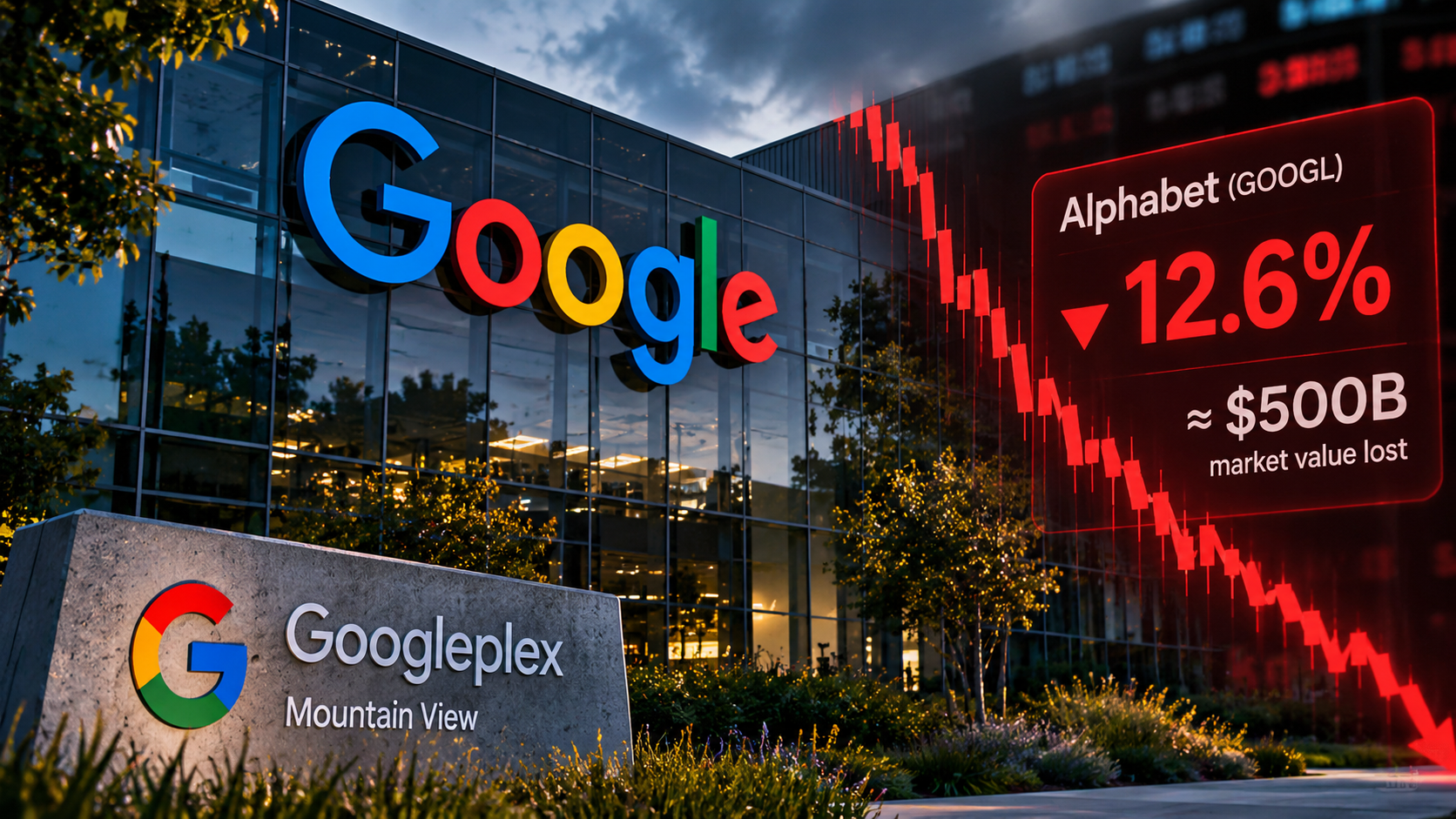
Alphabet shares plunged 12.6% after disappointing third-quarter results, wiping approximately $500 billion from the company’s market valuation. Behind the historic sell-off lies a growing question for the technology industry: Can artificial intelligence generate enough returns to justify its enormous cost?
A historic day for Google’s parent company
, Google’s parent company, Alphabet, suffered its worst trading day since going public in 2004 on Thursday, October 29, 2026, after its latest earnings report disappointed Wall Street.
Alphabet’s Class A shares fell 12.6%, eliminating approximately $500 billion in market capitalization in a single session.
The sell-off followed the company’s third-quarter earnings announcement on October 28, which revealed a combination of weaker-than-expected advertising revenue, declining net income and increasingly negative free cash flow.
The market reaction was particularly striking because Alphabet continued to report substantial growth across several business segments.
Quarterly revenue reached $127.6 billion, an increase of 25% compared with the same period in 2025.
Yet for investors, growth alone was no longer enough.
Strong revenue, disappointing expectations
Alphabet’s reported revenue of $127.6 billion fell below Wall Street expectations of approximately $128.2 billion.
The company’s advertising business generated around $82 billion, missing analysts’ expectations of $83.4 billion.
Although Google Search revenue continued growing, investors were concerned that the company’s traditional advertising business could face structural challenges as artificial intelligence changes how people search for information.
Net income attributable to common shareholders declined from approximately $35 billion in the third quarter of 2025 to $26.2 billion in the third quarter of 2026.
Alphabet reported diluted earnings per share of $2.12, compared with $2.87 a year earlier.
Meanwhile, adjusted earnings per share of approximately $2.67 fell short of analysts’ expectations of $3.02.
The figures highlighted an uncomfortable reality: Alphabet’s revenue was growing rapidly, but its bottom-line performance was under pressure.
The $9.1 billion cash-flow warning
Perhaps the most concerning figure in Alphabet’s financial results was its negative free cash flow.
During the third quarter, Alphabet recorded approximately $9.1 billion in negative free cash flow as it continued expanding artificial intelligence infrastructure and cloud computing capacity.
This followed another negative quarter, raising questions about how quickly the company’s investments will translate into sustainable cash generation.
Alphabet expects capital expenditure of approximately $195 billion to $205 billion for 2026, with management indicating that spending could increase substantially again in 2027.
These investments include data centers, specialized computing infrastructure and equipment needed to develop and operate increasingly powerful AI systems.
The strategy presents a difficult balancing act.
Spending too little could leave Alphabet behind competitors in the AI race. Spending too much without sufficient returns could put further pressure on cash flow and shareholder confidence.
Google Cloud doubles its revenue
Not every part of Alphabet’s earnings report disappointed.
Google Cloud emerged as a major source of growth, with quarterly revenue increasing 103% to approximately $30.7 billion.
The division benefited from growing demand for enterprise artificial intelligence, cloud infrastructure and Google’s proprietary Tensor Processing Unit technology.
Google Cloud’s operating income also rose substantially, reaching approximately $11.1 billion.
These results demonstrate that demand for AI infrastructure remains strong.
However, the cloud division’s performance was not enough to offset investor concerns surrounding Google’s advertising business and the cost of expanding its infrastructure.
The distinction is important: Alphabet’s AI products are attracting customers and generating revenue, but investors are increasingly focused on whether the resulting cash returns justify the investment.
Is artificial intelligence threatening Google’s search business?
Google faces a particularly complex challenge because artificial intelligence is both an opportunity and a potential threat to its existing business model.
Traditional search results have historically allowed Google to generate advertising revenue when users click sponsored links.
AI-powered search experiences increasingly provide direct answers to users’ questions, potentially changing how advertisements are displayed and monetized.
If users obtain the information they need without interacting with traditional search results, Google’s advertising economics could change.
Alphabet maintains that AI is helping drive search engagement, but the company’s latest results have intensified questions about how effectively AI-powered search experiences can generate advertising revenue.
The challenge is not necessarily that fewer people are using Google.
It is whether the company can monetize the next generation of search as effectively as the previous one.
What does this mean for the technology industry?
Alphabet’s historic sell-off reflects a broader shift in investor expectations surrounding artificial intelligence.
For several years, technology companies have benefited from optimism about AI’s potential to transform industries and create new revenue opportunities.
Now, investors are demanding clearer evidence that those opportunities can generate sufficient financial returns.
The market is increasingly distinguishing between companies demonstrating profitable AI adoption and companies whose spending is growing faster than their cash generation.
For Alphabet, the challenge will be to demonstrate that its expanding AI infrastructure can strengthen its core businesses while delivering sustainable returns.
The company’s strong cloud growth suggests substantial commercial demand. Its negative free cash flow illustrates the financial cost of meeting that demand.
Both realities can exist simultaneously.
A $500 billion warning for Big Tech
Alphabet’s stock market collapse does not mean Google lost $500 billion in operating cash or that the company is approaching financial failure.
The figure represents the approximate reduction in the market value of its outstanding shares following the sell-off.
Alphabet remains one of the world’s largest and most profitable technology companies.
Nevertheless, the market reaction sends a powerful message.
Investors are no longer willing to reward AI investment announcements automatically. They increasingly want evidence of monetization, profitability and disciplined capital allocation.
The next phase of the artificial intelligence race may therefore be decided by more than technological capability.
It may be determined by which companies can turn extraordinary computing power into equally extraordinary financial returns.
For Google, the pressure to deliver has rarely been greater.
Sources: Alphabet Inc., Third Quarter 2026 Financial Results (October 28, 2026); Reuters (October 28–29, 2026); Associated Press (October 29, 2026).
HCG News | Independent coverage of business, technology and financial markets.
Content type: News. See our editorial policy and corrections policy.