
Tesla's Flying Roadster Is Real Engineering. It Is Not Yet a Product.
On a Thursday evening in central Texas, a white two-seat sports car accelerated up a ramp that curled over until the car was hanging upside down. At the end of the track it left the surface, rolled through half a turn in the air and came down on its wheels. Minutes later the same kind of car, travelling along the ground, lifted itself over a Cybercab, a Cybertruck, a Tesla Semi, a Model Y and a Model 3, and landed on the far side.
There was nobody inside. According to Fox News, Elon Musk told the audience that automated controls were used so no one was put at risk.
The event, held on 15 October 2026 at SpaceX's rocket test facility in McGregor, near Waco, was Tesla's long-delayed unveiling of its second-generation Roadster — a car first shown in November 2017 and originally promised for 2020. It was also the most public demonstration yet of engineering collaboration between Musk's two best-known companies.
The central question for readers is not whether the stunt happened. It plainly did. The question is whether it changes what a road-going sports car can do — or whether the flying Roadster remains a showpiece sitting on top of a more conventional, still-unbuilt car.
A Roadster That Leaves the Ground
The demonstration consisted of two set pieces. In the first, the car drove up a curved ramp until inverted, held to the surface by an underbody suction system; compressed-gas thrusters then pushed it clear, and it rotated and landed. In the second, thrusters lifted the moving car over a line of five Tesla vehicles, as TechCrunch and others reported.
Three things were not shown. No person rode in the car during either manoeuvre. No sustained hover or point-to-point flight was attempted. And Tesla did not publish the height, duration or forces involved. WIRED, as summarised by NeoTeo, described the car rising a few dozen feet; HCG News could not confirm that figure against a Tesla source.
The aviation trade outlet AvWeb put the distinction plainly: the event did not establish whether the vehicle could perform sustained flight. That is the correct frame. What Tesla showed was a controlled, scripted, seconds-long airborne event — closer to a precision jump than to an aircraft leaving a runway.
The event almost did not happen in October at all. It was scheduled for 1 October, then postponed on 28 September, with Tesla citing weather and noting the show could only be held outdoors.
The SpaceX Engineering Connection
Two separate technologies do the work, and it helps to keep them apart.
Fan suction. Electric fans near the rear pull air from beneath the car, lowering the pressure under the floor so atmospheric pressure presses the car onto the surface. That extra downforce is what let the prototype cling to an inverted ramp. The idea has motorsport history: fan cars appeared in racing in the 1970s and were quickly banned for being too effective. Tesla calls its version a multi-mode suction system and fits it to all three trims. This is the part of the car most likely to matter on an ordinary road, because it improves grip without leaving the ground.
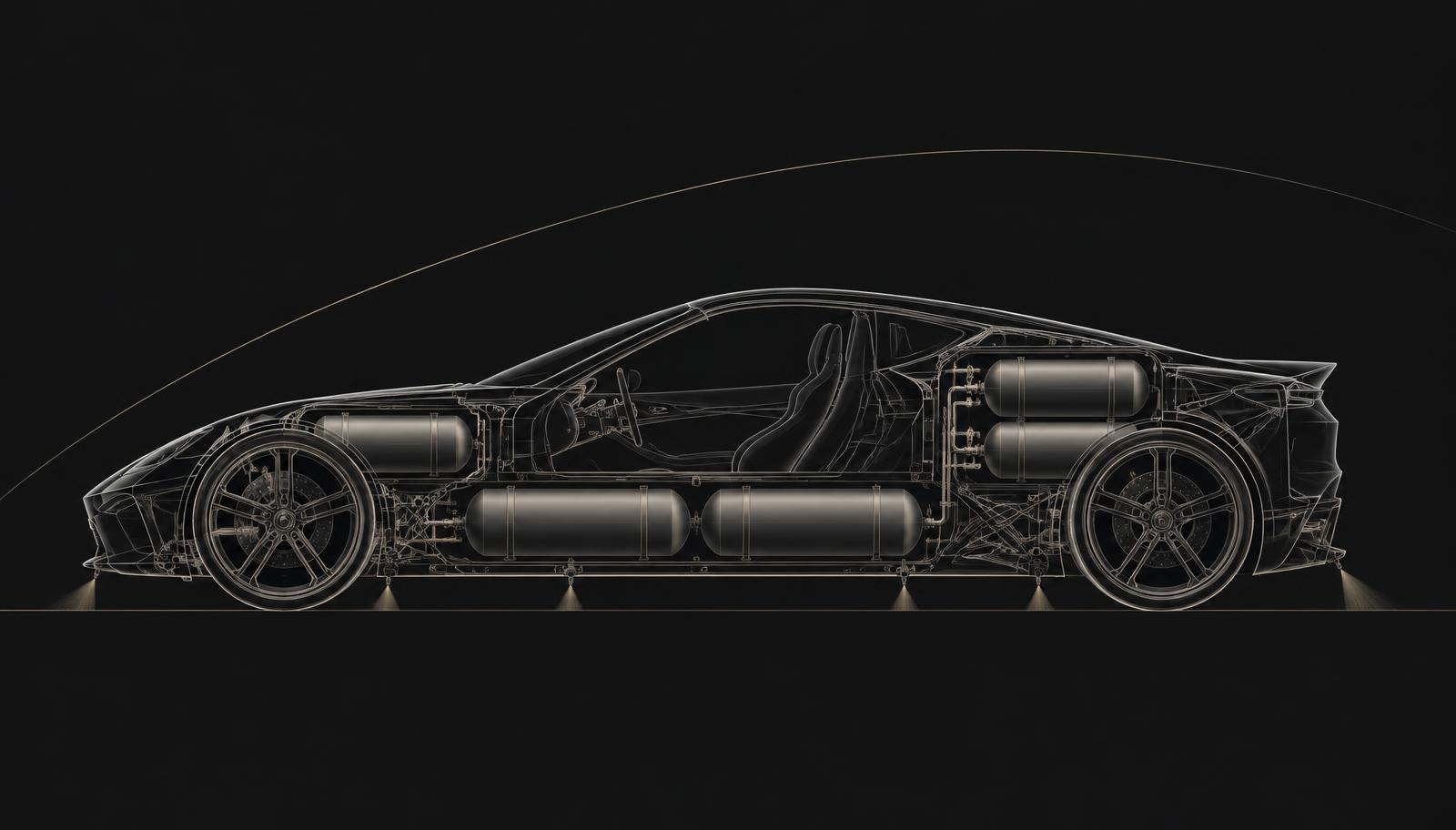
Cold-gas thrusters. A cold-gas thruster is the simplest kind of rocket. It burns nothing. It stores gas at very high pressure and releases it through a nozzle; the gas rushing out one way pushes the vehicle the other way. Spacecraft use them for small, precise attitude adjustments because they are reliable and easy to control.
Tesla engineering vice-president Lars Moravy said the Roadster uses 10 such thrusters connected to roughly 600 litres of compressed air, according to TechCrunch. Fox reported the split as a 200-litre vessel behind the seats on thruster-equipped cars, with a further 400 litres on the Rocket trim occupying the passenger space. Tesla said on X that carbon-fibre composite-overwrapped pressure vessels — the same family of tank used in rockets — fill every usable void in the car.
Tesla also claims the thrusters can produce four to five times the force the tyres can transmit. If accurate, that explains how the car could claim sub-one-second acceleration: thrust does not depend on tyre grip, which is normally the hard ceiling for any car's launch.
The physics also explains the limits. Compressed air stores very little energy for its weight compared with batteries or fuel, so the thrusters can fire only in short bursts before the tanks are empty. Moravy said, per Fox News, that fully refilling the Rocket prototype's system currently takes about six to seven hours, a figure Tesla hopes to reduce. HCG News found that detail in only one report.
Tesla has not published thrust per nozzle, operating pressure, tank mass, thruster energy consumption or the car's verified weight. Musk spoke of pumping air to around 10,000 psi when he first described the idea in 2018; Tesla has not confirmed the production figure.
What Tesla Has Actually Proven
It is worth sorting the claims into categories, because coverage has tended to blend them.
Demonstrated on camera: inverted driving on a ramp with suction; a brief airborne rotation and landing; a thruster-assisted hop over parked vehicles; a fast acceleration run that Tesla timed at about 0.81 seconds to 60 mph.
Claimed by Tesla, not independently verified: 0–60 mph in under 1.6 seconds (Performance), under 0.9 seconds (Thrust) and under 0.59 seconds (Rocket); a top speed above 230 mph; a range above 300 miles.
Inconsistent across sources: Top Gear reportedly heard from Tesla engineers that initial top speed would be 214 mph, with a faster version later. A weight target under 1,700 kg was reported, while technology reviewer Marques Brownlee publicly described the car as weighing more than 4,000 pounds. Tesla has not published a certified figure.
Aspiration only: Musk's remarks about eventually approaching half the speed of sound, and about possibly jumping Idaho's Snake River Canyon.
Not demonstrated: any occupied airborne manoeuvre, any sustained flight, any use on a public road, any production-intent vehicle completing independent testing.
The most important demonstrated fact is therefore narrower than the headlines suggest. Tesla has shown that a car-sized vehicle can use stored-gas thrusters for controlled, momentary lift and rotation. It has not shown that a customer can do so safely, repeatedly or legally.
Nearly a Decade of Expectations
The Roadster's history is the strongest reason for caution about its future.
Measured against the 2017 promise, the car has changed substantially. The concept was a four-seater with a claimed 620-mile range. The new car seats two (one in Rocket form) and claims over 300 miles — less than half the original figure, as Reuters reported.
Repeated slippage matters for a simple reason. A production date is a forecast, and a forecaster's track record is the best available guide to its reliability. Tesla has missed every Roadster production target set since 2017. That does not mean 2028 will be missed. It means readers should treat 2028 as an intention rather than a schedule until Tesla shows tooling, a supplier base and a validated production car.
The Business Behind the Spectacle
Why build an ultra-low-volume sports car at all? The orthodox answer is that it is a halo product — a car few people buy but many people notice, which lends prestige to the rest of the range. Morningstar analyst Seth Goldstein described it in exactly those terms, according to Reuters. Musk himself told the event he was unsure it would move the needle much on revenue, TechCrunch reported.
Investors appeared to agree on both counts. Tesla shares closed at $362.44 on the day of the event and traded about 5% higher in premarket the next morning, according to EV. JPMorgan reiterated a neutral rating. Analysts quoted by Reuters stressed that Tesla's third-quarter margins and cash flow, due on 21 October, would weigh far more than anything shown on stage. Before the event, the stock had fallen about 18% in 2026, Stocktwits reported.
The reservation model is the clearest financial signal. Tesla is asking $50,000 to reserve a Performance car and $250,000 for a Thrust car, both payable within ten days of an initial $5,000, with no final price announced. According to Tesla's reservation terms as reported by Fox News, the money is refundable until configuration but is not held in escrow, earns no interest, and Tesla does not guarantee when — or whether — a car will be delivered. A reservation is a place in a queue, not a purchase.
On the collaboration itself, the public record is thin. Musk and Moravy described joint work by Tesla and SpaceX engineers. HCG News found no official SpaceX statement on its contribution and no disclosed agreement covering how the technology was paid for, licensed or shared. Because Musk leads both companies, any such arrangement would be a related-party matter of legitimate interest to Tesla shareholders. Analyst Gene Munster told Reuters the event illustrated why Musk wants to bring the two companies closer together; no combination has been announced.
The Challenges of Making It Real
Regulation. The Federal Aviation Administration told CBS News and other outlets that "the Tesla vehicle does not meet the FAA definition of an aircraft." That is a classification statement, not an approval. It suggests the FAA does not expect to certify the car — but it also means no aviation framework governs its airborne capability. CBS reported that a senior Department of Transportation official acknowledged there was no clear answer on oversight. HCG News found no public statement from the National Highway Traffic Safety Administration.
In the United States, manufacturers self-certify that cars meet federal safety standards; regulators do not pre-approve designs. No federal standard bans thrusters by name, but high-pressure tanks, exposed nozzles and a vehicle designed to leave the ground raise questions those standards never anticipated. Tesla's own listing says the Rocket trim is not approved for public road use and is not available in all regions. Asked about legality, Musk reportedly said it "depends on your street". International markets, with type-approval regimes stricter than the US model, are likely to be harder still.
Safety. Musk said earlier this year that safety was not the main goal for the Roadster and advised safety-focused buyers to look elsewhere, according to TechCrunch. Composite pressure vessels are proven technology but store a great deal of energy; failures of related tanks have caused SpaceX launch-pad accidents. Crash protection, tank integrity after impact, and the effect of thruster blast on pedestrians and other road users are all open questions Tesla has not publicly addressed.
Insurance and liability. No insurer has published a position. Pricing risk for a car whose most distinctive feature is its ability to briefly leave the ground will be difficult, and in many jurisdictions using that feature on a public road would likely fall under reckless-driving or street-stunt law.
Practicality. Hours-long refills, limited thrust duration and lost cabin space mean the thrusters are best understood as a track or exhibition feature.
The Competitive Landscape
Comparisons with flying-car and eVTOL companies are tempting but mostly misleading. Firms such as Joby and Archer are building aircraft designed to carry passengers for tens of miles under FAA certification — a process Decrypt notes can take five to nine years for a new type. Alef Aeronautics, the closest analogue as a road-and-air vehicle, received a limited experimental airworthiness certificate in 2023 for testing.
Sustained hovering is energetically brutal: a 2021 study cited by Decrypt found electric aircraft need several times more power per kilogram to hover than to cruise. A few seconds of compressed-air thrust sidesteps that problem by not attempting it. Tesla is not competing with eVTOLs; it is doing something different, and far shorter.
What Happens Next?
This section is independent interpretation, separate from the reported facts above.
The most commercially meaningful technology shown on 15 October may be the least theatrical one. Fan-driven suction is mechanically straightforward, works continuously from the battery, and directly improves grip, braking and cornering on ordinary tarmac. If Tesla can make it reliable and road-legal, it would be a genuine differentiator for a performance car.
The thrusters are a different proposition. They store little energy, take hours to refill, consume cabin space, add high-pressure hazards and face an undefined legal status. Their value to Tesla is likely to be less about customers using them than about what they signal: that Tesla and SpaceX can integrate aerospace hardware into a consumer product at speed. That signal has strategic value in a period when Tesla is asking investors to fund AI, robotics and autonomy — though it is not the same as a revenue line.
For reservation holders, the economics deserve plain language: a buyer placing $250,000 is extending an unsecured, interest-free deposit against a product with no price, no certified specifications and a target date that has moved repeatedly. That is a reasonable choice for an enthusiast who understands it. It is not a delivery contract.
CONCLUSION
Has Tesla's collaboration with SpaceX fundamentally changed what a road-going sports car can do? On the evidence available at our cutoff, not yet.
Tesla has demonstrated something new: a car that can, for a few seconds and with no one aboard, use rocket-style thrusters to leave the ground and come back under control. That is a real engineering achievement and should be recognised as one. But the capability that makes the headlines belongs to a one-seat, invitation-only trim that Tesla itself says is not approved for public roads. The car most buyers can actually reserve is a two-seat electric sports car with powerful fan suction and impressive claimed numbers — none yet independently verified, none yet in production, and attached to a company that has missed every Roadster deadline it has set.
The flying Roadster today is best described as a credible technology demonstration with significant commercial, regulatory and safety obstacles ahead. Whether it becomes more than that will be decided not on a stage in Texas, but in spec sheets, test results, regulatory filings and factory output over the next two years.
HCG News has no commercial relationship with Tesla or SpaceX. HCG News did not interview anyone quoted in this article; quotations are attributed to the outlets that reported them. Performance figures are manufacturer claims unless stated otherwise.
Verified vs. Claimed
| Capability | Demonstrated evidence | Tesla's claim | Current uncertainty |
|---|---|---|---|
| Inverted driving via suction | Shown on camera, ramp climb | Multi-mode suction on all trims | Effectiveness on public roads, dust/debris, noise, durability |
| Airborne rotation & landing | Shown once on camera, unoccupied | Rocket trim is "air ready" | Height/duration unpublished; no occupant; not repeatable evidence |
| Hop over vehicles | Shown on camera, unoccupied | 10 thrusters, ~600 L air | Not tested with a person aboard; legality unknown |
| Sustained flight / hover | Not demonstrated | Not explicitly claimed as sustained | Energy physics make it unlikely with compressed air |
| 0–60 mph | Tesla-timed run ~0.81 s | <1.6 / <0.9 / <0.59 s by trim | No independent timing; rollout method unstated |
| Top speed | Not demonstrated | >230 mph | Conflicting reports (214 / 330 mph) |
| Range | Not demonstrated | >300 miles | Battery size unpublished |
| Weight | Not published | Target <1,700 kg (reported) | Conflicts with "4,000+ lb" public claim |
| Road legality | — | Performance "road ready"; Rocket "not approved for public road use" | No NHTSA statement; state rules vary |
| Aviation status | FAA statement | — | FAA: not an aircraft; no framework for airborne use |
| Production | — | 2028 | Every prior target missed |
| Price | — | Not announced | Deposits $50k / $250k / invite-only |
Sources
| Source | Publisher | Date | Used for |
|---|---|---|---|
| Tesla reveals SpaceX-powered Roadster that flies and falls with style | TechCrunch | 15 Oct 2026 | Demonstration, trims, deposits, thruster details, delay history |
| Tesla Roadster flies, flips and hits 60 mph in a flash | Fox News | 18 Oct 2026 | Location, automated control, tank volumes, refill time*, trim claims, reservation terms |
| Tesla unveils Roadster with thrusters, targets 2028 production | Reuters (via Honolulu Star-Advertiser) | 16 Oct 2026 | 2028 target, range comparison, analyst comments |
| We asked the DOT who would oversee a flying car like Tesla's Roadster | CBS News | Oct 2026 | FAA statement, DOT oversight question |
| WIRED reports FAA says Tesla Roadster falls outside its aircraft definition | NeoTeo, summarising WIRED | Oct 2026 | No occupant, reported height* |
| Tesla Roadster Takes Flight | AvWeb | Oct 2026 | Sustained flight not established |
| Tesla is unveiling the new Roadster for real this time, promise | Electrek | 13 Oct 2026 | Postponement |
| Tesla 'flying' Roadster demo could come this month, with no one inside | Electrek | 14 Aug 2026 | 2026 demo delays |
| Elon Musk said the Tesla Roadster can fly. This new patent suggests otherwise | Electrek | 6 Aug 2025 | Ground-effect patent |
| Tesla delays 'flying' Roadster demo to April Fools' Day | Electrek | 6 Nov 2025 | Nov 2025 timeline |
| Tesla Roadster Rocket Is the Cool 'Flying' Car You Can't Have | Decrypt | Oct 2026 | Certification timelines, Alef precedent, hover energy |
| Tesla Shares Jump as Flying Roadster Wows Fans and Splits Skeptics | EV | 16 Oct 2026 | Share price, JPMorgan rating |
| TSLA Stock Slips Overnight Ahead Of Roadster Event | Stocktwits | 15 Oct 2026 | Year-to-date share performance |
| Roadster | Tesla (primary) | Accessed 20 Oct 2026 | Trim availability by region |
| Tesla Roadster (second generation) | Wikipedia | Accessed 20 Oct 2026 | 2017–2025 timeline (reference only) |
* Supported by a single source.
Demonstration author used for sample content while the newsroom is being set up.
Content type: Analysis. See our editorial policy and corrections policy.