
Make Data Smart 2026: Norway’s AI Ambitions Move Towards Real-World Implementation
Norwegian businesses are increasingly adopting artificial intelligence. At Make Data Smart in Oslo, the discussion centred on what comes next: connecting AI to company knowledge, integrating it into existing systems and turning experimentation into practical value.
HCG News | 2 November 2026
Conference report and analysis
Artificial intelligence is becoming a practical business question: how can organisations make it work reliably within their everyday operations?
That was my strongest impression from Make Data Smart 2026, hosted by Dataforeningen at the Radisson Blu Scandinavia Hotel in Oslo on Monday. The conference brought together professionals working with data, analytics and AI, alongside established businesses and startups. (dataforeningen.no)
The conversations reflected an appetite for implementation. Businesses are exploring how AI can support employees, connect information across systems and automate parts of their operations.
Yet enthusiasm was accompanied by an important question: what separates an impressive demonstration from a dependable business tool?
AI adoption accelerates in Norway
Statistics Norway’s latest figures show how quickly adoption is changing. In 2026, almost five in ten Norwegian enterprises with at least ten employees reported using one or more AI technologies, compared with three in ten in 2025.
The gap between larger and smaller businesses remains substantial. Around eight in ten enterprises with at least 100 employees use AI, compared with four in ten among businesses employing between ten and nineteen people.
Administration, business management, marketing and sales are now among the common applications identified by Statistics Norway. The technology is reaching well beyond specialist development teams. (ssb.no)
Investment priorities also suggest growing interest. In May, IT services company Nordlo reported figures from research company Radar indicating that the share of Norwegian small and medium-sized businesses prioritising AI investment had risen from 11 per cent in 2022 to 75 per cent in 2025.
These figures describe investment priorities rather than actual expenditure. Nevertheless, they indicate how prominently AI now features in business planning. (nordlo.com)
Context matters as much as capability
One word appeared repeatedly in my notes from the conference: context.
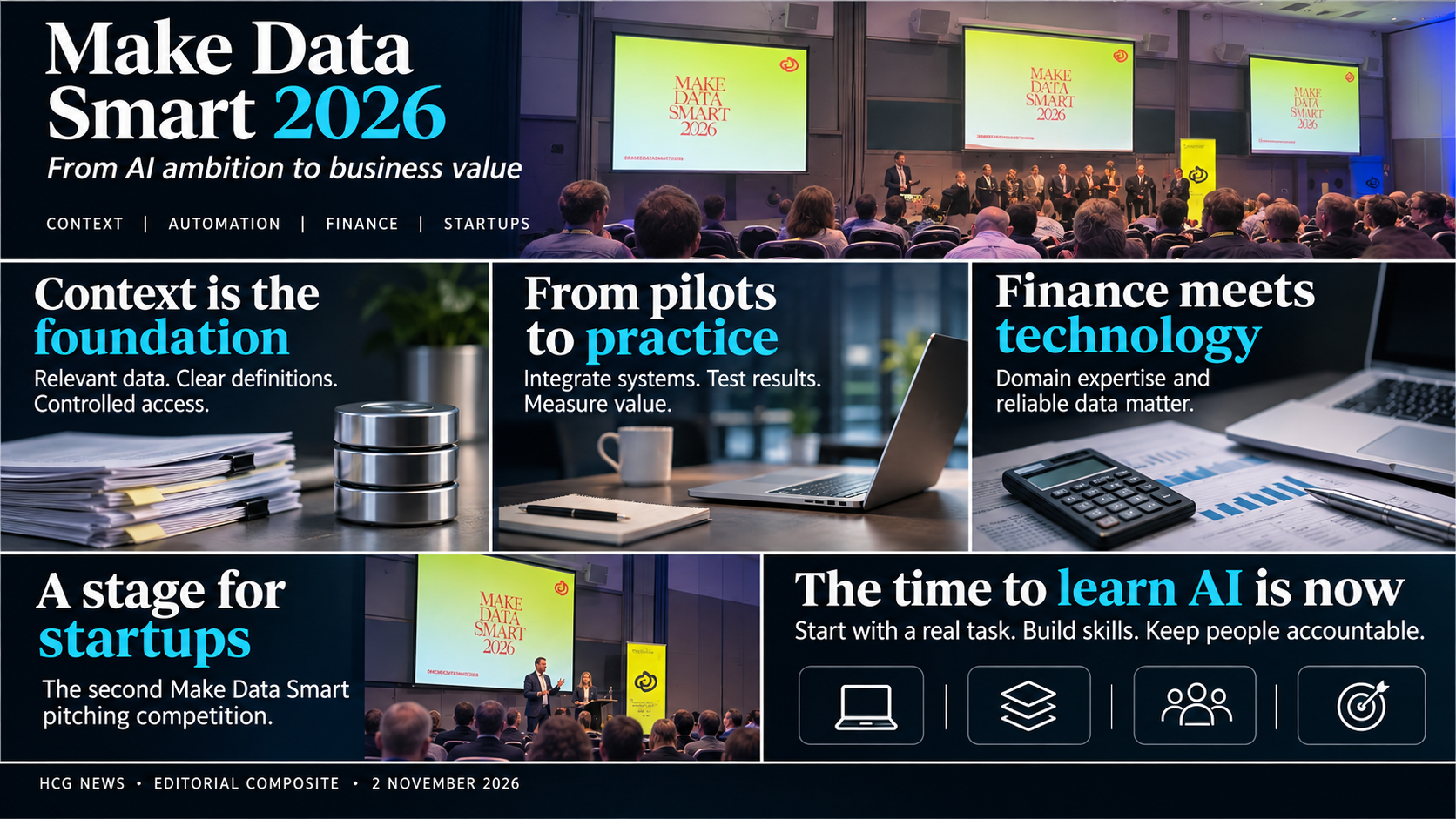
A model can possess extensive general knowledge while knowing very little about the business using it. To provide useful assistance, it needs relevant information, clear definitions and an understanding of the task.
Consider a seemingly straightforward question: “How are sales performing?”
A meaningful answer depends on the reporting period, the products involved and whether “sales” means signed contracts, issued invoices or money received. Without those distinctions, a fluent response can still be misleading.
For businesses, providing context therefore means organising knowledge so that systems can use it accurately and within appropriate access boundaries.
The conference programme reflected this emphasis. Norges Bank Investment Management’s session connected AI agents with governed data catalogues and structured context. NAF’s presentation focused on business logic and employee competence as foundations for reliable AI-assisted analysis. (dataforeningen.no)
The practical implication is clear: purchasing access to a capable model is only one part of the work. Businesses also need to understand their own information.
Finance and technology become increasingly intertwined
The presence of financial institutions illustrated how closely technology and business operations are connected.
DNB’s Nicolai Rygh addressed the distance between quickly building a convincing prototype and delivering a functioning product. SpareBank 1 SMN’s programme contribution examined how AI-generated information can itself create data-quality problems. (dataforeningen.no)
These are particularly important questions in finance, where decisions depend on accurate information and controlled access.
My assessment is that the competitive advantage will increasingly come from combining technical capability with subject knowledge. Understanding financial processes, customer needs and operational responsibilities remains essential when introducing automation.
The same reasoning applies beyond finance. Technology becomes more useful when it is built around the work people actually need to accomplish.
Moving towards automation—with purpose
The atmosphere at Make Data Smart suggested a willingness to move beyond isolated experiments and explore AI within everyday workflows.
That does not mean every task should be automated immediately.
A useful starting point is a clearly defined problem: locating information in internal documents, preparing an initial report or sorting incoming enquiries. The business can then assess accuracy, time saved and the situations that still require human judgement.
This creates a stronger basis for investment than deploying technology without a measurable objective.
Nordlo’s account of the Radar findings also identifies internal competence and data quality as obstacles to implementation. The message is relevant: investment in software needs to be accompanied by investment in people and the information those systems depend on. (nordlo.com)
Digital visibility deserves attention
For businesses without an effective website, these developments should prompt reflection.
A clear, current website provides a place where potential customers can understand an organisation, assess its services and find reliable contact information. In my view, businesses without that foundation risk making themselves harder to discover and evaluate.
Word of mouth still matters. Personal recommendations and trusted relationships remain valuable. But those recommendations can lead to an online search—or a question directed to an AI assistant.
Businesses should therefore consider how clearly their expertise and services are represented online.
The changing nature of web traffic adds another dimension. Thales’ 2026 Bad Bot Report puts automated bot traffic at more than 53 per cent of web traffic in 2025, based on its research data. That includes different types of automated activity; it does not mean that half of all traffic comes from AI assistants or prospective customers. (cpl.thalesgroup.com)
The distinction matters. Businesses need to be visible to people while also understanding how automated systems interact with their websites.
A second pitching competition puts startups in the spotlight
According to the organisers, this was the second time Make Data Smart had hosted its startup pitching competition. The published 2025 programme also documents the previous edition. (dataforeningen.no)
This year’s programme provided space for four startups to present to the audience and a panel drawn from Norway’s startup community. (dataforeningen.no)
From my perspective as an attendee, the competition was a successful part of the day. It brought energy to the programme and gave emerging businesses an opportunity to put their ideas before people working directly with data and AI.
Building on last year’s event, Dataforeningen again created a valuable meeting point between new ideas and established experience.
For a startup, that opportunity extends beyond the presentation itself. Questions, feedback and conversations can help founders understand where their solutions might create value—and what still needs work.
The time to learn AI is now
My strongest takeaway is straightforward: now is the time to learn how to use AI thoughtfully.
That does not require every business owner to become a software engineer. It does require curiosity, a willingness to test assumptions and an understanding of where the technology can help.
Start with a real task. Learn what information the system needs. Check its output. Measure whether it improves the process.
The opportunity for Norwegian businesses lies in bringing technology, professional expertise and responsible implementation together. Progress depends on people who understand both the tools and the problems they are trying to solve.
Thank you to Dataforeningen, the speakers, the participating startups and everyone who shared their experience throughout the day. Wishing them every success as the ideas and conversations from Make Data Smart become practical work.
Content type: Analysis. See our editorial policy and corrections policy.