
ERP 2026: Why Businesses Are Spending More on Technology Without Solving Their Biggest Problems
From implementation failures and hidden subscription costs to artificial intelligence and organizational resistance, ERP 2026 highlighted a growing challenge for modern businesses: enterprise systems are becoming more powerful, but not necessarily easier to manage.
Technology & Enterprise | HCG News | October 30, 2026
Enterprise Resource Planning (ERP) systems are designed to bring businesses together. Finance, procurement, human resources, inventory, operations and reporting can all operate through interconnected systems intended to improve efficiency and decision-making.
Yet for many organizations, implementing ERP software remains an expensive, complicated and sometimes disappointing experience.
At ERP 2026, presentations examining implementation economics, change management, software vendors and total cost of ownership revealed challenges that extend far beyond choosing the right technology.
Independent research from Prosci, Gartner, McKinsey and other industry organizations reinforces many of these concerns.
The central question is no longer simply whether businesses need ERP systems.
It is whether the systems businesses are building today can remain financially sustainable, adaptable and useful tomorrow.
The 92% problem: Technology receives the investment, but people determine the outcome
One of the conference’s most striking presentations focused on the imbalance between technological investment and organizational change.
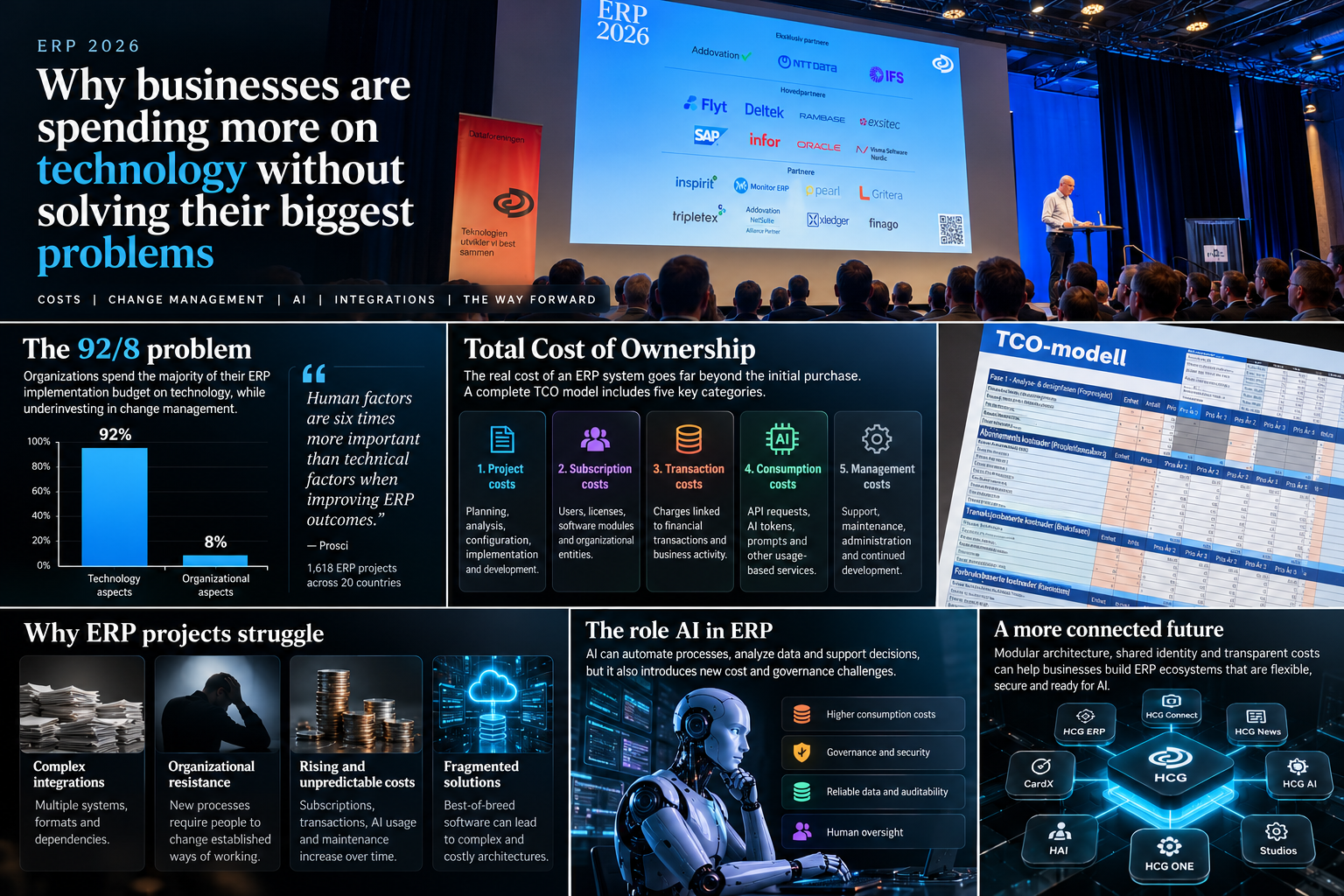
Research presented by Prosci, involving 1,618 ERP implementation professionals, found that organizations allocated approximately 92% of ERP implementation budgets to technical activities and just 8% to change management.
Yet respondents identified human factors as six times more important than technical considerations when assessing opportunities to improve implementation outcomes.
The implications are significant.
A company can invest millions in software, integrations, infrastructure and consulting while underinvesting in employee training, communication and organizational readiness.
When a new system is introduced, employees may need to abandon established workflows, learn unfamiliar processes and adapt to new responsibilities.
Without effective change management, even technically successful implementations can struggle to deliver their expected benefits.
This concern is supported by Boston Consulting Group, which estimated in a 2024 analysis that more than half of ERP transformation projects fail to achieve their objectives.
The lesson is straightforward: Installing software and transforming an organization are not the same thing.
ERP costs extend far beyond the original contract
Another major topic at ERP 2026 was the financial structure of enterprise software.
A Total Cost of Ownership (TCO) model presented at the conference illustrated five categories of expenditure:
Project costs: Planning, analysis, configuration, implementation and development.
Subscription costs: Users, licenses, software modules and organizational entities.
Transaction costs: Charges associated with financial transactions and other business activity.
Consumption costs: API requests, AI tokens, prompts and other usage-based services.
Management costs: Support, maintenance, administration and continued development.
These categories reveal why comparing ERP providers exclusively on subscription prices can be misleading.
The original purchase may represent only a fraction of the system’s lifetime expenditure.
As an organization expands, new employees, additional integrations, increased transaction volumes and more sophisticated automation can all contribute to rising costs.
The problem becomes particularly challenging when companies cannot easily predict how their usage will develop over several years.
Gartner identifies implementation complexity, inadequate planning, poor organizational alignment and integration difficulties among the risks affecting ERP projects.
A financially responsible ERP strategy therefore requires more than an initial budget.
It requires continuous visibility into the system’s true operating costs.
Fragmented systems create expensive dependencies
ERP 2026 also illustrated the diversity of the enterprise software market.
Solutions from major international providers coexist with regional platforms, specialist applications and industry-specific systems.
This diversity gives organizations considerable freedom when choosing software.
However, it also creates another problem: interoperability.
A company may use one application for accounting, another for inventory, a third for customer relationships and additional platforms for analytics, document management and artificial intelligence.
Each system may work well independently.
But connecting them can introduce significant technical and operational complexity.
Data formats must be aligned. Access permissions must be coordinated. Integrations require maintenance. Software updates can introduce compatibility problems.
Over time, businesses may accumulate a network of applications that becomes increasingly difficult to understand, replace or modernize.
Boston Consulting Group has highlighted the importance of coordination between organizations and their implementation partners, particularly when multiple service providers are involved.
The solution is not necessarily to eliminate specialized software.
Instead, businesses should consider architectures in which applications can communicate through documented interfaces, shared data standards and clearly defined responsibilities.
This approach can allow individual components to evolve without requiring the entire organization to replace its technology infrastructure.
Artificial intelligence introduces a new financial challenge
Artificial intelligence is becoming increasingly relevant to enterprise software.
AI-powered systems can assist with financial analysis, document processing, forecasting, customer support and repetitive administrative work.
However, AI also introduces cost structures that traditional ERP procurement models were not necessarily designed to accommodate.
Deloitte’s January 2026 research on AI token economics argues that traditional TCO models need to evolve to account for consumption-based AI expenditure.
Unlike conventional fixed-price software subscriptions, AI services may generate costs based on the number of requests, tokens processed, models used and infrastructure resources consumed.
A workflow that appears inexpensive during testing can become substantially more costly when deployed across an entire organization.
Autonomous or semi-autonomous AI agents introduce additional complexity because one user request may trigger several model calls, external API requests and automated processes.
EY has similarly identified consumption, platform infrastructure, governance, workforce, failure recovery and compliance as important categories in assessing the full cost of enterprise AI agents.
This means businesses should ask a new set of questions before adopting AI functionality:
How much does each automated task cost? Which department is responsible for the expenditure? Can consumption be monitored? What happens when an automated process fails? And who has the authority to approve consequential actions?
Without clear answers, artificial intelligence risks becoming another layer of complexity rather than a solution to existing problems.
AI cannot compensate for weak ERP foundations
The relationship between AI and ERP is not simply about adding intelligent features to existing applications.
It also depends on the quality of the underlying enterprise architecture.
In January 2026, McKinsey warned that businesses investing aggressively in AI while neglecting their core ERP capabilities could undermine their ability to deploy AI effectively.
Disconnected data, inconsistent business processes and inadequate governance can prevent promising AI demonstrations from becoming reliable enterprise solutions.
The problem is particularly important when AI systems begin interacting with financial records, sensitive business information or operational workflows.
An AI assistant may be capable of recommending an action.
But a business still needs to determine whether that action is permitted, who authorized it, how it should be recorded and whether it can be reversed.
McKinsey emphasizes the importance of human oversight, reliable data, logging and governance when integrating AI agents into enterprise operations.
For businesses, this suggests that AI should be introduced as part of a broader architectural strategy rather than as an isolated technological experiment.
A different approach: Modular architecture, shared governance and transparent costs
Several of the problems discussed at ERP 2026 point toward common architectural principles.
First, businesses need greater transparency over technology expenditure, including subscriptions, transactions, integrations and AI consumption.
Second, enterprise applications should be designed for interoperability, allowing information to move between systems without unnecessary duplication.
Third, identity management, access permissions and organizational governance should be consistent across connected applications.
Fourth, systems should be modular enough to accommodate new technologies without requiring complete replacement.
Finally, organizations must retain meaningful human oversight, especially where automation affects security, finances or important business decisions.
These principles are also influencing how newer technology ecosystems are being designed.
Hakmi Capital Group, for example, is developing an interconnected software ecosystem that includes enterprise management, centralized access governance, business applications and AI-related infrastructure.
Its architectural direction emphasizes shared identity, modular services and centrally managed permissions, with security and system-rule changes remaining under manual human control.
The objective is to explore how independently developed applications can function as parts of a coordinated environment rather than becoming disconnected software products.
This remains a developing approach, not proof that the longstanding challenges of ERP implementation have been solved.
Nevertheless, it reflects a broader industry question: Could organizations reduce complexity by treating interoperability and governance as foundational requirements instead of expensive additions?
The future of ERP may look very different
In May 2026, McKinsey explored how artificial intelligence could fundamentally change the way organizations interact with ERP systems.
Instead of navigating complex menus and manually completing every transaction, employees may increasingly interact with intelligent interfaces that coordinate tasks across enterprise applications.
The underlying systems would still remain responsible for records, business rules, compliance and auditability.
This creates an important distinction.
The future of ERP may involve fewer visible software boundaries, but it will not eliminate the need for reliable enterprise architecture.
In fact, greater automation may make that architecture even more important.
Organizations will need to balance innovation with security, flexibility with standardization, and automation with accountability.
Conclusion: Better technology is not enough
The discussions at ERP 2026 exposed a fundamental challenge facing modern organizations.
Businesses are investing in increasingly sophisticated technology while continuing to struggle with implementation costs, organizational change, integration complexity and long-term system management.
Artificial intelligence promises new efficiencies, but also introduces additional questions about cost, reliability and governance.
The next generation of enterprise software will therefore need to do more than provide additional features.
It must make business systems easier to connect, understand, operate and improve.
The real measure of a successful ERP system is not how much technology an organization purchases, but how effectively that technology supports the organization over time.
And as AI becomes a larger part of enterprise operations, that distinction may become more important than ever.
Sources and further reading
Editorial disclosure: HCG News is associated with Hakmi Capital Group. The article references HCG’s developing software ecosystem as an example of one architectural approach. The independent research cited does not constitute an endorsement of HCG products.
Conference photographs: HCG News.
Content type: Analysis. See our editorial policy and corrections policy.
Related

Tesla's Flying Roadster Is Real Engineering. It Is Not Yet a Product.
Tesla's new Roadster left the ground on 15 October — briefly, and with no one inside. Our inaugural feature separates the engineering from the expectations.